
2026 FLARE Annual Meeting
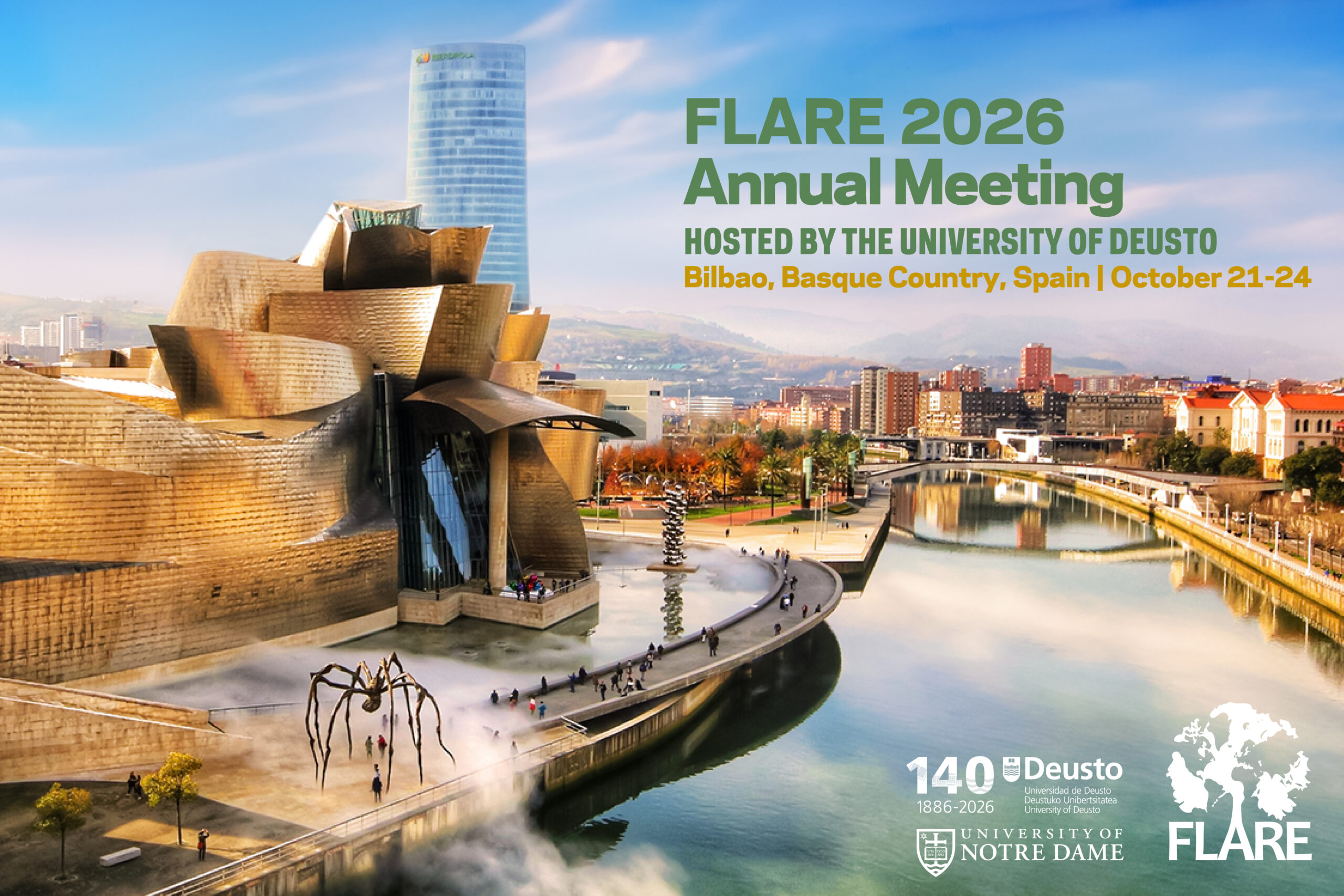
The 12th FLARE Annual Meeting will be held from October 21-24, 2026 in Bilbao, Spain in partnership with the University of Deusto.
The Secretariat is excited to release the 2026 Annual Meeting Program. Click the button to view it below.
The FLARE Annual Meeting Sponsors





Keynote and Plenary Sessions
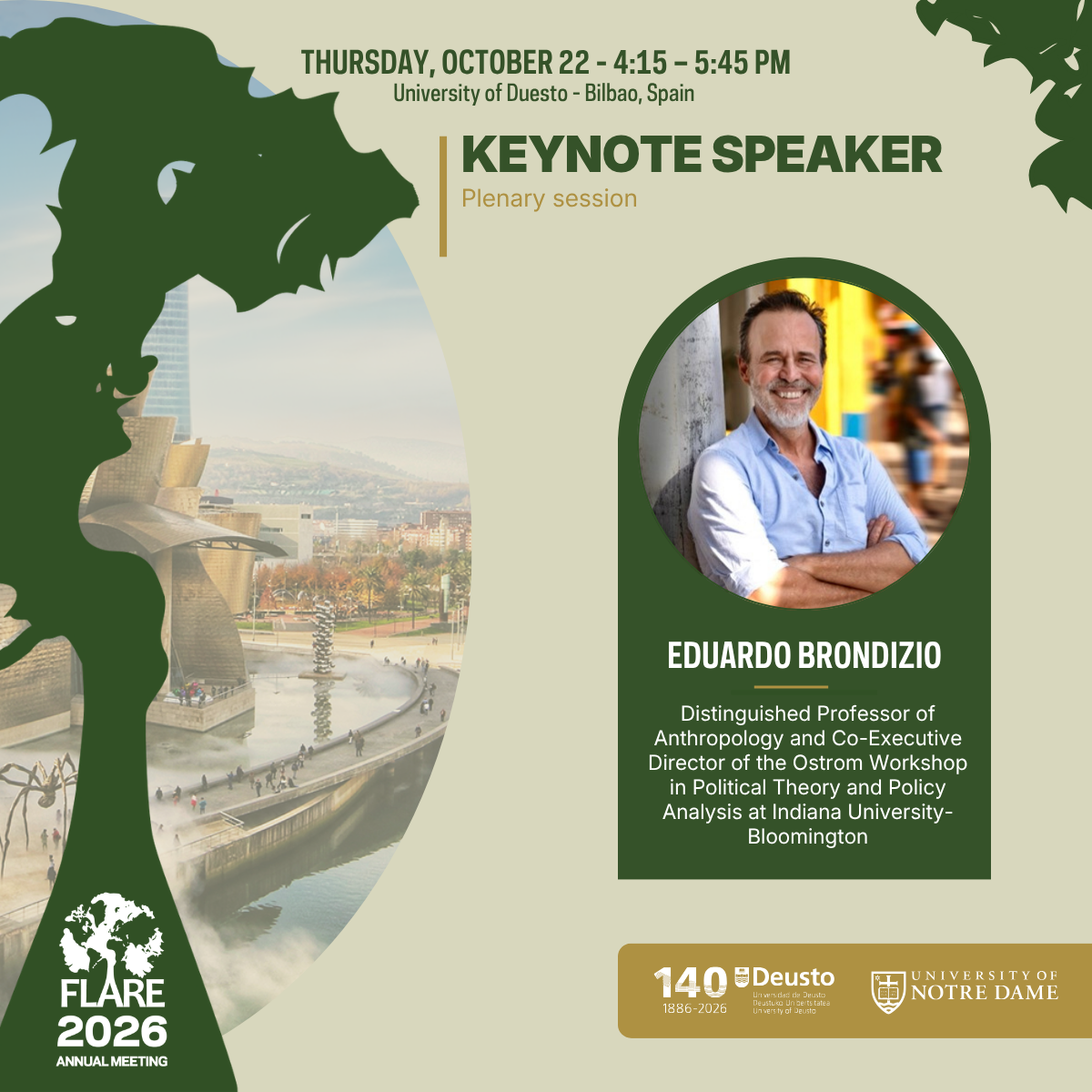
The FLARE Secretariat is excited to announce Dr. Eduardo Brondizio as the 2026 Keynote Speaker!
Eduardo S. Brondizio is a Distinguished Professor of Anthropology, directs the Center for the Analysis of Social-Ecological Landscapes, and is Co-Executive Director of the Ostrom Workshop in Political Theory and Policy Analysis at Indiana University-Bloomington. Brondizio’s research has documented, analyzed, and responded to the social-environmental transformation and governance challenges of Amazônia. His work has contributed new methodologies for linking ethnographic research, household and community surveys, institutional analysis, geospatial and ecological assessments, and Indigenous and local knowledge, contributing to multiscalar understandings of land-use processes such as deforestation and reforestation, agroforestry and agricultural intensification, migration and urbanization; biodiversity product value-chains; population vulnerability to climate change; and the governance of complex landscape arrangements.
He has contributed to numerous international initiatives on global environmental and climate change and sustainability. Brondizio served as co-chair of the Global Assessment Report of the Intergovernmental Platform on Biodiversity and Ecosystem Services (IPBES).
Brondizio is an elected member of the American Academy of Arts and Sciences (AAAS) and the United States National Academy of Sciences (NAS), and an international member of the French Academy of Agriculture (AAF). Brondizio was awarded the 2023 Volvo Environmental Prize and the 2025 Tyler Prize for Environmental Achievement.
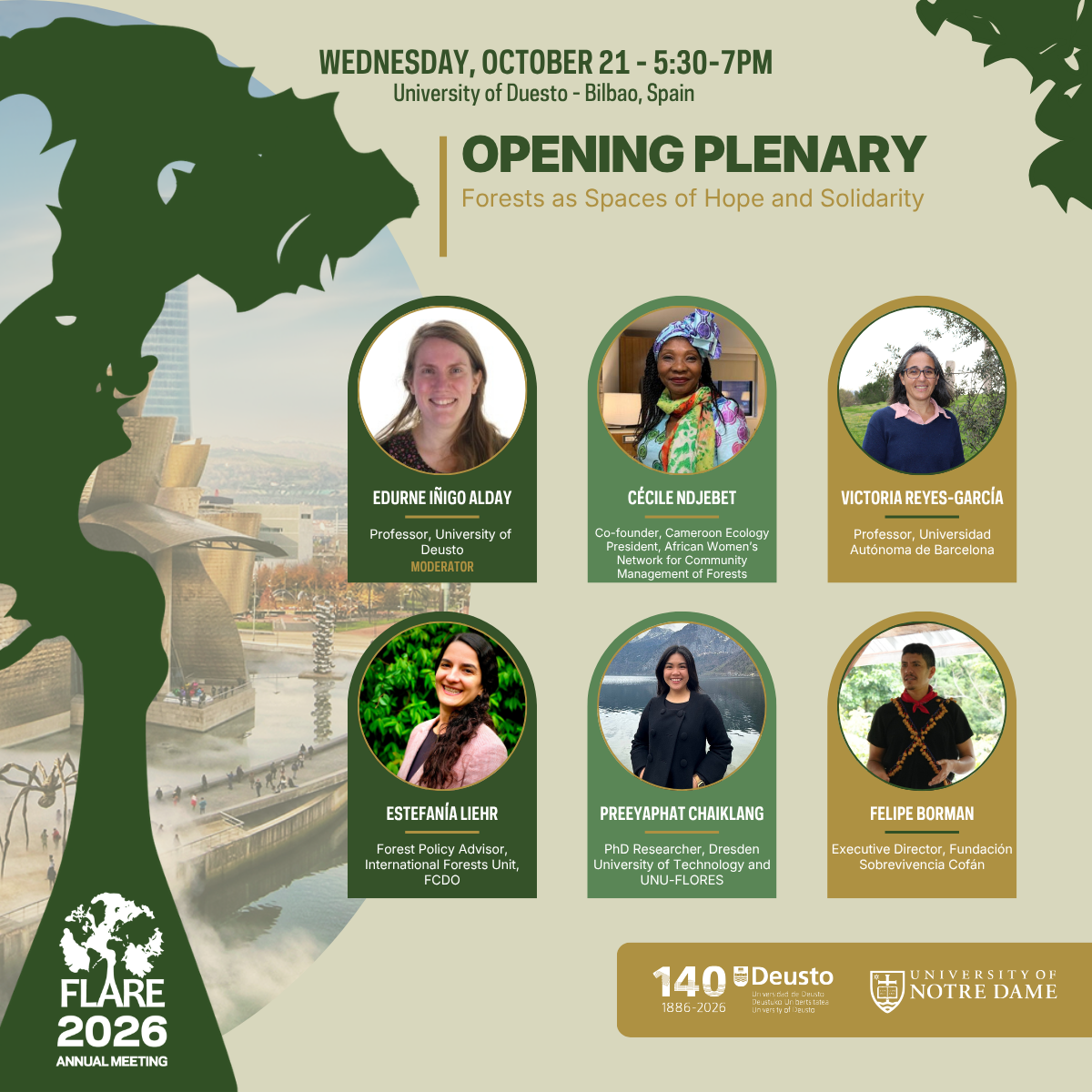
Opening Plenary Panel on Forests as Spaces of Hope and Solidarity
The opening plenary for the 12th FLARE Annual Meeting will feature a roundtable discussion among diverse participants from around the world on the conference theme of "Forests as spaces of hope and solidarity." Panelists will share their experience, expertise, and perspectives on this timely and relevant topic, which will set the stage for the remainder of the Annual Meeting. They will also field questions from the audience. Discussion will continue informally after during the Opening Reception for FLARE 2026. We look forward to seeing you there!
2026 Annual Meeting Theme
Forests as Spaces of Hope and Solidarity
Forests worldwide are symbols of hope. Hope, not as passive optimism or blind faith, but rather as a courageous commitment to possibility amidst uncertainty. Forests are also literal spaces of hope for hundreds of millions of people around the world who rely on them for their livelihoods and well-being. Hope can inspire collective action and mutual support. Hope and solidarity are needed to conserve, restore, and sustainably manage forests. But contemporary challenges—wanton disregard of social norms, stubborn violence, yawning inequality, technology-fueled alienation, climate breakdown, and more—conspire to undermine hope and solidarity.
Yet hope persists, manifesting in new forms of solidarity and collective action toward better futures.
We invite speakers to integrate this theme— forests as spaces of hope and solidarity— into their proposals for the 12th Annual FLARE Meeting.
2026 Annual Meeting Registration
Meeting registration fees are based on a tiered structure according to country income level.
Conference registration includes a personal 3-day conference pass with on-site lunch and two coffee breaks per day (except for Saturday, October 24th). The opening reception is included, but ticketed. Please choose that option during registration if you wish to attend. All rates end on the date stated at 11:59 PM Eastern Standard Time (U.S.)
High Income Country | Early Bird June 17 - July 20 | Regular Rates July 21 - September 25 | Final Rates September 26 - October 21 |
|---|---|---|---|
Student Presenter | $345 | $385 | $450 |
Professional Presenter | $615 | $700 | $765 |
Student Observer | $315 | $365 | $420 |
Professional Observer | $590 | $680 | $750 |
Poster Presenter (applies to Student and Professional) | $345 | $385 | $450 |
Upper Middle Income Country | Early Bird June 17 - July 20 | Regular Rates July 21 - September 25 | Final Rates September 26 - October 21 |
|---|---|---|---|
Student Presenter | $260 | $305 | $370 |
Professional Presenter | $440 | $515 | $595 |
Student Observer | $230 | $280 | $350 |
Professional Observer | $395 | $470 | $550 |
Poster Presenter (applies to Student and Professional) | $260 | $305 | $370 |
Low & Lower Middle Income Country | Early Bird June 17 - July 20 | Regular Rates July 21 - September 25 | Final Rates September 26 - October 21 |
|---|---|---|---|
Student Presenter | $180 | $220 | $250 |
Professional Presenter | $250 | $300 | $350 |
Student Observer | $120 | $150 | $200 |
Professional Observer | $195 | $250 | $280 |
Poster Presenter (applies to Student and Professional) | $180 | $220 | $250 |
All Levels | Early Bird June 17 - July 20 | Regular Rates July 21 - September 25 | Final Rates September 26 - October 21 |
|---|---|---|---|
Welcome Reception October 21, 2026 University of Deusto | Free, but ticketed | Free, but ticketed | Free, but ticketed |
Welcome Reception Guest Ticket (Not attending conference) | $30 | $30 | $30 |
Conference Dinner October 23, 2026 Guggenheim Museum | $95 | $95 | $95 |
Guest Dinner Ticket (Not attending conference) | $95 | $95 | $95 |
Presentation Guidelines
Please review the guidelines before completing your presentation or poster.
Frequently Asked Questions
Do you have a question regarding the 2026 Annual Meeting? Please review the section below to find your answer. If you cannot find your answer, please reach out to us at flare@nd.edu.
The following hotels have been suggested to the Secretariat by staff at the University of Deusto.
- Radisson Hotel - Gran Via Bilbao
- Miro Hotel
- Hesperia Bilbao
- Barceló Bilbao Nervión
If you wish to find a short-term rental apartment, FLARE suggests the nearby neighborhoods of Abando, Indautxu, Casco Viejo, and Deusto. This website, among others, provides additional information about neighborhoods in Bilbao.
Yes. The Organizing Committee will allow for new presenters if the originally stated presenter cannot attend the Annual Meeting. However, there will be a strict limit of two presentations for any one presenter. If the proposed substitute is already presenting twice, please choose another presenter.
Many nationalities will need a Schengen visa when travelling to Spain. Please check with your nearest consulate to verify if you need to apply for a Visa.
If you need a letter of acceptance from the FLARE Secretariat for visa purposes, please email the Secretariat at flare@nd.edu as soon as possible. FLARE can only provide an official letter of acceptance to you to apply for a tourist visa. FLARE is unable to write to consulates to support your Visa application.
The 12th Annual Meeting will be an in-person event only for the parallel sessions. The Secretariat reserves the right to remove a presentation if the presenter cannot attend.
The deadline to submit a proposal is April 20th. Please see the abstract submission guidelines above for further information.
All decisions for submissions for the 2026 Annual Meeting will be announced on May 22nd via email.
The pre-organized panel session option on Oxford Abstracts is reserved for those who have coordinated with an organizer to create an entire session around a certain topic relating to the themes of the 2026 Annual Meeting. If you plan to submit your abstract as part of a pre-organized session, please refer to the Abstract Guidelines for the proper procedures.
FLARE will offer a limited number of scholarships to provide funding for travel and accommodations. During the abstract submission process, please complete the form linked in the submission portal. Presenters from low and middle income countries will be prioritized.
FLARE Network Announces Two New Student Awards
The Forests and Livelihoods (FLARE) Network is pleased to announce two new awards for students presenting at the 2026 FLARE conference: the Best Paper Award and the Engaged Research Award. Each award carries a cash prize, which will be delivered during the closing ceremony on Saturday, October 24th.
The Best Paper Award recognizes an outstanding student paper that advances understanding of the relationships between forests and the people who rely on them, judged on academic quality, novelty, and relevance to forest livelihoods.
The Engaged Research Award recognizes student research carried out in meaningful partnership with forest communities, practitioners, or policymakers, and/or that delivers clear benefits beyond academia.
Both awards are open to students at any stage of their education, from undergraduate through doctoral study. We look forward to learning more about the excellent student work to be presented at FLARE 2026!
Important Dates
Dates subject to change
DATES | EVENT |
|---|---|
May 22 | Abstract decisions notifications announced |
June 17 | Early bird registration begins |
July 20 | Early bird rate ends; regular registration rates apply |
September 25 | Deadline to register as a presenter Regular registration ends; final rates apply |
September 26 | Late registration rates apply |
October 7 | Official Program released |
October 21 | Opening Reception + Plenary Event + Poster Session |
October 22 | Day 2 of Annual Meeting |
October 23 | Day 3 of Annual Meeting; FLARE group dinner at the Guggenheim Museum |
October 24 | Final Day of Annual Meeting |
Recommendations for Bilbao
Bilbao is a vibrant, major metropolis and the industrial and cultural heart of the Basque Country, straddling the Nervión River. Situated in a lush green valley along an estuary near the Bay of Biscay, Bilbao provides a wonderful cultural and culinary experience to every traveller. See the FLARE Secretariat's tips below to make your trip safe and memorable!
Recommended activities, restaurants and more in Bilbao and the surrounding Basque Country!
Arrival & Transportation
- By bus: Bizkaibus A3247 is the cheapest way into town. Buses leave from outside the arrivals terminal every 15–20 minutes and stop at Plaza Moyúa, Gran Vía, and Bilbao Intermodal (the central bus station). The ride takes about 25 minutes. You can purchase a Barik card (see below) to cover the bus fare and use it for all public transportation in Bilbao and surrounding provinces. It is available at a kiosk just inside the terminal doors from where the bus departs.
- Taxis wait outside arrivals and cost about €25–€35 to central Bilbao. Uber and Cabify also operate.
- By train: Trains arrive at Abando Station (Estación de Abando Indalecio Prieto) in the city center.
Getting around
Barik card: This rechargeable transit card is sold at metro stations and newsstands. One card can be shared by several travelers, and it gives discounted fares on the Metro, the Tram, Bilbobus, Bizkaibus and Euskotren. It makes coastal day trips easy and affordable without a car.
Metro Bilbao: You'll know the entrances by their Norman Foster glass tubes. The metro is fast across the city and runs out to the coast (Getxo, Sopela, Plentzia).
Tram (Tranvía): The green tram runs along the river, linking Casco Viejo, the Guggenheim and the University of Deusto area.
Walking: Bilbao is very walkable, and the riverfront (Ría de Bilbao) is often the nicest and quickest route between central neighborhoods.
Weather and What to Pack
October is usually mild, around 12–20 °C (54–68 °F).
Expect some light rain (the locals call it sirimiri). Pack a waterproof jacket, a small umbrella and comfortable walking shoes. Layers work well for cool mornings and warm afternoons.
Money
The currency is the euro (€).
Contactless Visa and Mastercard are accepted almost everywhere, including on transport and in pintxo bars. Carry €10–€20 in small notes and coins for small traditional taverns.
Language and etiquette
Spanish and Basque (Euskera) are both official languages. English is common in hotels, tourist areas and universities.
Useful Basque words: Kaixo (hello, pronounced kai-sho), Aupa (casual, friendly greeting similar to "hey" or "what's up"), Eskerrik asko (thank you), Agur (goodbye).
Meal times are different than in many countries. Lunch is later -- about 14:00–15:30 or more, dinner from 20:30, and pintxo bars are busiest from about 19:30.
In pintxo bars, you typically indicate the pintxo you want from the bar, order hot ones from the board, and pay at the end of your time at the bar by telling the staff what you had. It works on an honor system.
Tipping in Bilbao is optional. Service is already included in prices, and nobody expects a 15–20% tip as in the US and other countries.
Cafés and pintxo bars: Most people tip nothing. If you like, round up or leave the small coins from your change, usually 10 to 50 cents. People often leave them on the little dish the change comes on.
Sit-down restaurants: Tipping isn't required. If the service was good, locals usually round up or leave about 5–10%. That's often a few euros, and up to around 10% for a nicer meal or a large group.
Paying by card: The card machine often won't have a tip option, so it's easiest to leave a few coins in cash.
Many shops close on Sundays, and some restaurants close on Sunday evenings and Mondays.
Health and emergencies
The emergency number is 112 (police, fire, medical).
Tap water is safe and good to drink.
Pharmacies have a green illuminated cross, and staff can advise on over-the-counter medicines.
Plugs are Type C/F (two round pins), at 230 V / 50 Hz. If you're coming from outside Europe, bring a universal adapter.
Power
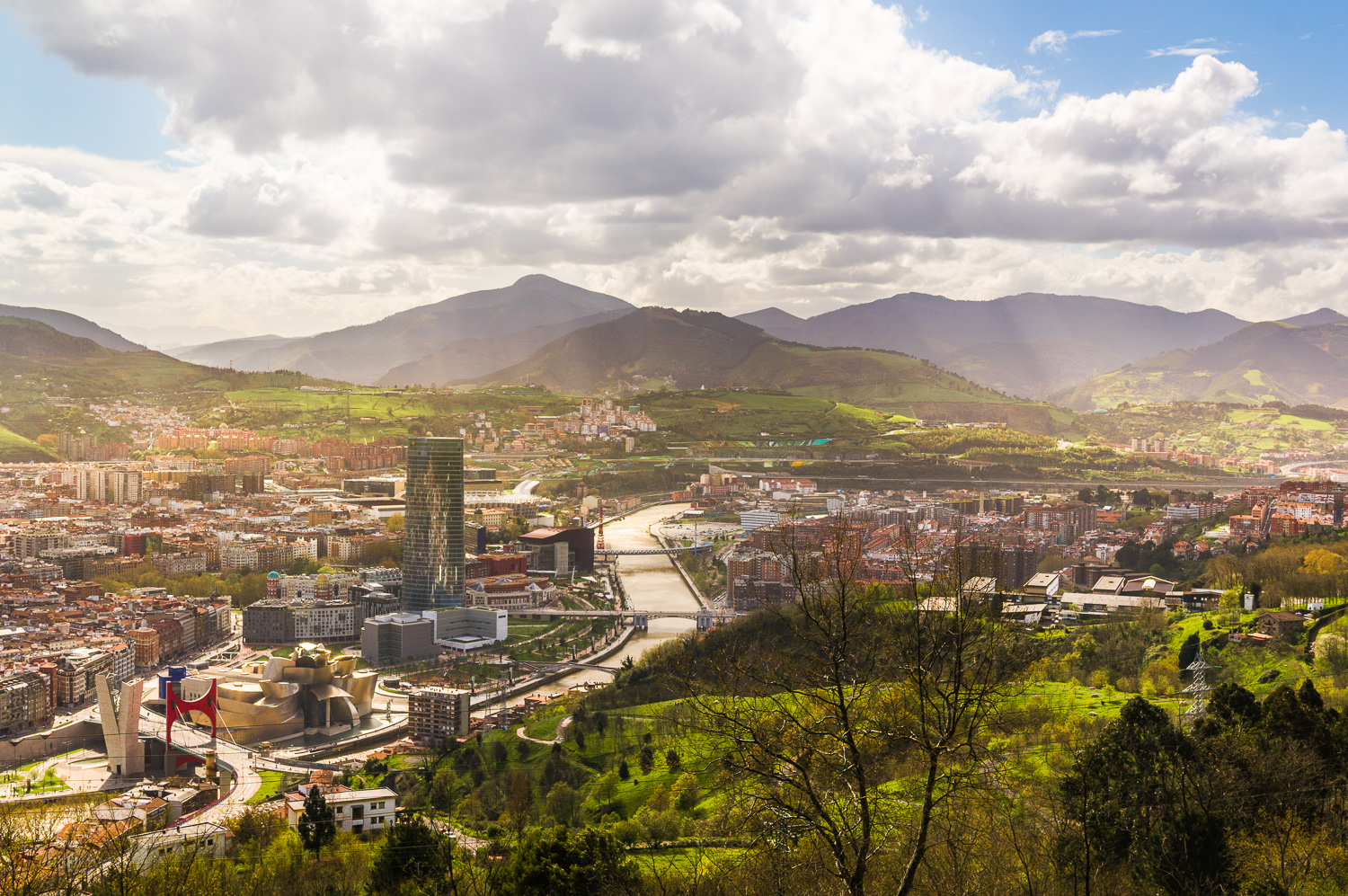
Photo by Tommie Hansen (https://web.archive.org/web/20161024194733/http://www.panoramio.com/photo/89402964)
2026 FLARE Annual Meeting Commitees
Coordination Committee
Local Host
- Francisco Javier Arellano Yanguas, University of Deusto
- Edurne Iñigo Alday, University of Deusto
- Ainhoa Jorquera Cascón, University of Deusto

FLARE Network Secretariat:
Keough School of Global Affairs
University of Notre Dame
1010 Jenkins Nanovic Halls
Notre Dame, IN 46556-5677
USA
