
Policy Briefs
FLARE Policy Brief Series on Forests and Livelihoods
The FLARE Network's policy brief series aims to connect high-quality research to policy discussions at the intersection of forests and livelihoods. The series draws on the deep and diverse expertise within the FLARE community to advance knowledge and action on key contemporary issues relating to climate, biodiversity, poverty, social justice, forest governance and more. The series is co-published with the Keough School of Global Affairs, home of the FLARE Network secretariat. Please also see our companion series of short policy-relevant videos.
2025 Annual Meeting Conference Briefs
Beyond Carbon: Elevating the Adaptive Role of Forests in the Global Goal on Adaptation
Climate policy has emphasized the contributions forests make to mitigating global climate change through carbon sequestration and reducing greenhouse gas emissions due to forest loss. This focus has meant that the
critical, multifaceted role of forests in climate change adaptation has been overlooked, jeopardizing forest ecosystems and the well-being and resilience of billions of people who rely on them worldwide.
Key Recommendations
• Integrate forests, trees, and the people who rely on them explicitly in
climate adaptation policies given the critical role of forests and tree-based
systems.
• Adopt metrics within the GGA Indicator Framework that can be
adapted across scales and that reflect local contexts, ecosystems
and priorities.
• Establish sustainable finance and multi-level coordination for long-term
community-based monitoring (CBM) that links data on local forests and
forest proximate communities with national climate reporting.
Forests and Transformative Change Strategic Pathways toward a Sustainable and Equitable Future
This brief synthesizes the discussion, which focused on the systemic reconfigurations necessary to address the dual crises of biodiversity loss and social inequity. The panel emphasized that while global trajectories often appear grim, a profound opportunity exists to catalyze positive shifts by realigning governance, restoration practices, food chains, and financial systems based on a vision of collective agency.
Key Recommendations
- Ensure Tenure Security Beyond Titling: Policy should move beyond the bureaucratic act of granting land titles to ensuring comprehensive tenure security. This includes providing communities with the legal and financial resources necessary to defend their territories in court, resist external threats, and fully determine their relationship with their land.
- Shift Governance Priorities to Local Contexts: Multilateral and national regulations should prioritize frameworks that support local livelihoods and economies. Rather than focusing exclusively on “deforestation-free” products for foreign export, legal reforms should empower the informal and small-scale sectors that sustain local well-being.
- Integrate Food and Forest Policies: Connect food system transformation with forest protection by fostering local economies that reduce pressure on natural ecosystems.
Read more about the discussion and other key recommendations by clicking the link below.

Transformational Change Toward a Sustainable Future
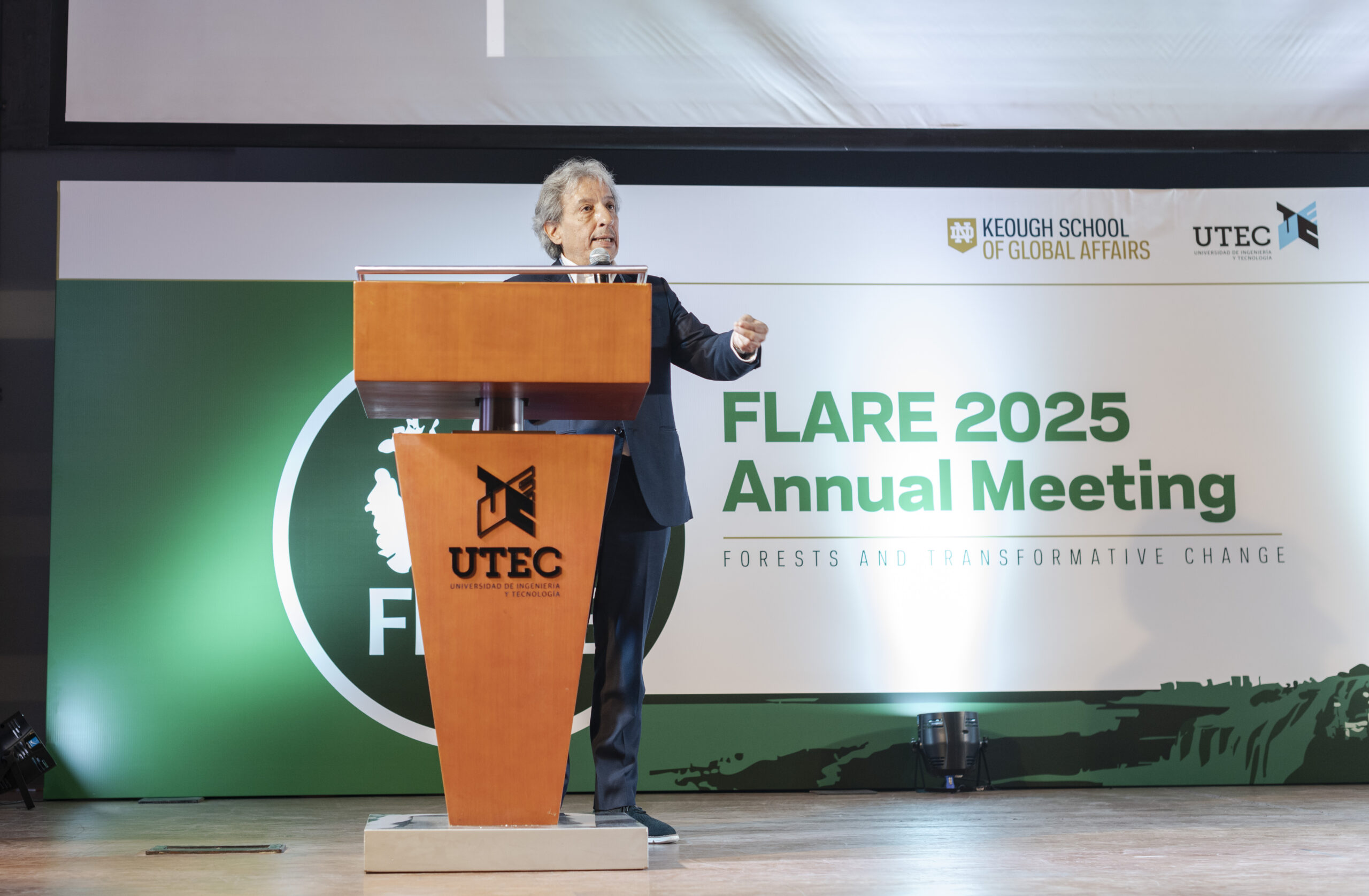
During the 11th FLARE conference held in Lima, Peru, Manuel Pulgar-Vidal presented a strategic roadmap to address current global sustainability challenges through the concept of transformation. To facilitate the understanding of this complex agenda, he employed the metaphor of the human body: the head represents the vision, the heart represents the actions that motivate us, the digestive system represents the integration of knowledge, and the legs represent the support needed to walk toward the future.
Although the current geopolitical context presents significant hurdles—including a rise in skepticism, denialism, and shifts in the political priorities of major powers—the core message is one of hope and determination. Transformational change is not merely an environmental necessity but an irreversible economic process that ensures long-term competitiveness and development.
Read more about the discussion and key recommendations by clicking the link below. You can also view the full keynote address on YouTube.
Conservation and Coexistence in the Andes-Amazon
The final plenary panel of the 11th Annual Meeting convened
leading experts, policymakers, the private sector, and voices from local and Indigenous communities. Dr. Anne Larson moderated the
session, with Valbina Miguel, Yanesha activist and artist; Marco Arenas, former Director of Biodiversity, Peruvian Ministry of Environment;
Gabriel Quijandría, IUCN Regional Director for South America and former Minister of the Environment of Perú; Lucía Ruiz, ASRI-UTEC
and former Minister of the Environment of Perú; and Jorge López-Dóriga, AJE Group, a global beverage company focused in sustainability, Chief of Communications and Sustainability
Officer, as panelists.
The panelists gave ten recommendations to enhance the conservation and coexistence in the Andes-Amazon region. Five recommendations focus on necessary transformations of economic, social, and cultural
relationships related to the Amazon and its people and five outline the systemic, regulatory, and financial changes needed to support
the desired future.
Read more about the discussion and the ten recommendations by clicking the link below.

Policy Briefs
A Global Review of the Impact of Forest Property Rights Interventions on Poverty
The first policy brief in the series, titled “A Global Review of the Impact of Forest Property Rights Interventions on Poverty”, provides a comprehensive analysis of how property rights over forest resources alleviates poverty. Authored by Daniel C. Miller and colleagues, this brief synthesizes findings from a systematic review of 91 case studies across 24 countries. The research underscores the importance of the secure forest-related property rights for local community livelihoods.
Community Forest Governance: Supporting better outcomes for people and the planet
In recent years, there has been growing momentum behind forest restoration and other nature-based solutions to address climate change and biodiversity loss, yet their impacts on local livelihoods remain underexplored.
This brief (1) analyzes three forest benefits central to global policy debates—contributions to local livelihoods, carbon storage, and biodiversity—to better understand the exchanges and synergies between human and environmental objectives in forest policymaking and (2) suggests policies for government, donors, and program implementers to maximize positive outcomes and minimize risk to both people and the planet, such as:
- Granting legal recognition to local management authorities and empowering their participation in rule-making
- Investing in further analyses at the national and sub-national levels
- Taking a locally-responsive approach to policy and program development

FLARE Network Secretariat:
Keough School of Global Affairs
University of Notre Dame
1010 Jenkins Nanovic Halls
Notre Dame, IN 46556-5677
USA
